Applying Growth Strategy to The DoorDash Campus Launcher Role
Every campus has that one moment: late at night, after a long day of classes, when students are tired, hungry, and just want something quick and affordable to eat. Delivery apps are there, but often overlooked or too expensive for students to commit to long-term.
That’s where DoorDash’s Campus Launcher role comes in: a chance to connect students with their local food scene, test real product growth strategies, and turn DashPass from a one-time trial into a daily habit.
I started imagining what it would look like to bring DashPass to life on my campus; not just promoting it, but scaling it like a startup and embedding it into the culture of student life. Here’s the strategy I’d use to make DashPass an essential part of everyday campus living.

1. Objective Setting: Finding a Growth Goal That Matters
To make DashPass more than just a flyer on a table, I needed to start with a clear goal: a growth target that proves students truly find value in the product.
- My North Star Metric: How many students are there that use DashPass at least 3 times during their free trial?
2. Users: Understanding Them and Their JTBD
But before setting tactics in motion, it’s important to understand who we’re designing for and what real problems DashPass can solve in their daily campus life.
Jobs to be done:
- “I want food fast when I’m too tired/busy to cook”
- “I want deals that help me stretch my budget”
- “I want to know what’s popular and worth trying”
Understanding this helps us position DashPass as more than a use of convenience, but core to the modern lifestyle experience.
3. Product Fit: What makes DashPass Fit Student Life?
With the student mindset in focus, the next step is to highlight why DashPass naturally fits into campus living and how it stands out in a crowded space of delivery options.
For many students, these are the key factors in subscribing:
- Value: Free delivery at only $4.99 a month with the first month free. A low risk offer that’s great for students.
- Convenience: Being able to order local favorites from anywhere frees up time for students to spend more on classes, studying, campus life, etc.
- Community Fit: DashPass can fit directly into the lifestyle that students already have. Whether it’s delivering local pizza to a club event, social gathering, or for a movie night, DashPass can make food a part of any moment.
4. Metrics & Measurement: Tracking What Matters
A growth strategy is only as good as its ability to measure progress. While my North Star Metric is the number of students who use DashPass three or more times during their free trial, supporting metrics help track the funnel from awareness to habit formation:
Awareness:
- Event reach (tabling interactions, flyer scans, club announcements)
- Social media impressions and engagement on student channels
Acquisition:
- Number of free trial sign-ups by week
- Conversion rates from tabling, QR codes, and referrals
Retention:
- Percentage of students placing their second and third order during the trial
- Average time between orders (e.g., trial day 1 → day 5 → day 10)
Feedback Loop:
- Number of survey responses or Instagram poll interactions
- Common suggestions or complaints, grouped into themes
By monitoring these numbers week-to-week, I can quickly see what’s working (e.g., club collaborations driving signups) and where to iterate (e.g., students signing up but not ordering again). This turns growth from guesswork into a measurable experiment.
5. Growth Pillars & Marketing Strategy
Identifying what makes DashPass relevant is only half the equation. To grow effectively, we need to define how success will be measured at every stage of adoption.
Pillar 1: Awareness
How can we reach as many students as possible? How can we make it relevant to them?
- High Traffic Tabling: Dining halls, student unions, in front of the gym; Use giveaways and visuals to attract curiosity.
- Club Collaborations: Not only do clubs have to the greater student network, but they offer built-in engagement through recurring meetings, social media posts, and on-campus events.
- Localized Flyers: Colleges have a lot of spirit and pride. A potential way to tap into that is by having custom mottos that make DoorDash, a globally recognized brand, truly feel local. Something like: “Order Burgers and Boba from Bidwell Park”, with a sketch-like filter of the location. Locals recognize local, and by recognizing the local community, they’ll recognize the product.
Pillar 2: Acquisition
How can we get students to sign up for DashPass?
- Incentivised Tabling: Free swag for signing up, make it simple and immediate with a QR code.
- Referral Raffles: “Bring a friend” strategy with low-cost, high-appeal prizes like gift cards.
Pillar 3: Habit Formation
How can we encourage students to keep using DashPass?
- Themed Weekly Deals: Push notifications on local deals or mid-day specials.
- Social Media Proof: Show stories from real students or a “Chico DashPass Trending”.
Pillar 4: Iteration
What’s working? What isn’t? How can we receive feedback to improve?
- End-of-Trial Feedback: Before their trial ends, offer a questionnaire on the attractive and improvable aspects of the product. Afterward, their reward can be picked up at the campus table.
- Instagram Story Polls: A fast, visual, and quantifiable way to get the general campus vibe.
- QR Code Tracking: Campaign flyers, dorms, or clubs to see where growth is coming from.
- Adjust based on input: Improve where we know we can.
6. User Research and Insights
Even with a strategy on paper, no plan survives first contact with real users. Before launching any campaign, I’d start by observing and listening to students on campus.
How I’d gather insights:
- Micro-interviews: Quick, casual chats with students around campus to learn how they order food, what they like or dislike about delivery, and where DashPass could make their lives easier.
- Surveys & Polls: Short digital polls in student group chats and social channels to capture broader trends and pain points.
- Observation: Spending time in dining halls, dorm lounges, and study areas to see real ordering behavior in action.
- Feedback Loops: Creating a simple way for students to share suggestions or frustrations about food delivery on campus, turning their input into actionable ideas for DashPass growth.
SWOT Analysis: Understanding DashPass on Campus
From these early insights, we can see where DashPass shines, where friction exists, and what external factors we need to navigate. A quick SWOT analysis makes this clearer.
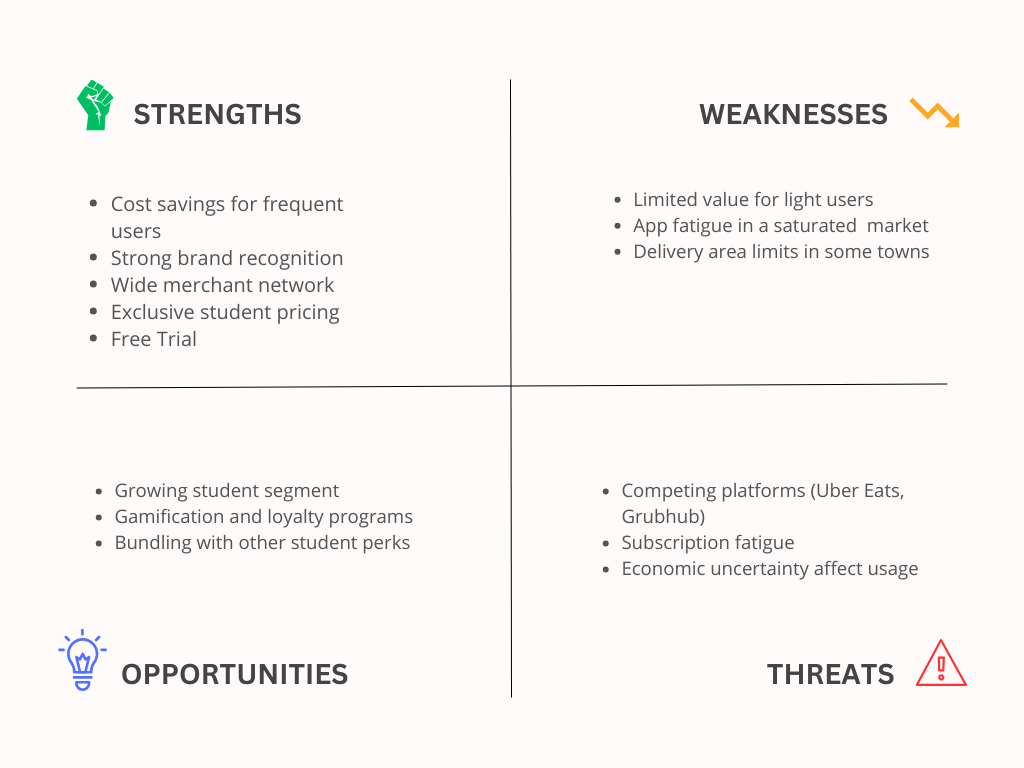
This breakdown helps focus the growth plan on overcoming weaknesses (awareness and trial-to-subscription conversion) while doubling down on opportunities (community partnerships, peer-driven adoption).
Final Thoughts
Pulling all these elements together, the Campus Launcher role isn’t just about handing out flyers; it’s about testing, learning, and growing a product that genuinely makes students’ lives easier. By treating campus like a live lab, focusing on measurable behavior change, and iterating on real student feedback, DashPass can shift from a trial offer to an everyday essential. That’s the kind of growth strategy and product adoption that lasts beyond one semester.